EAN: 5908277717773
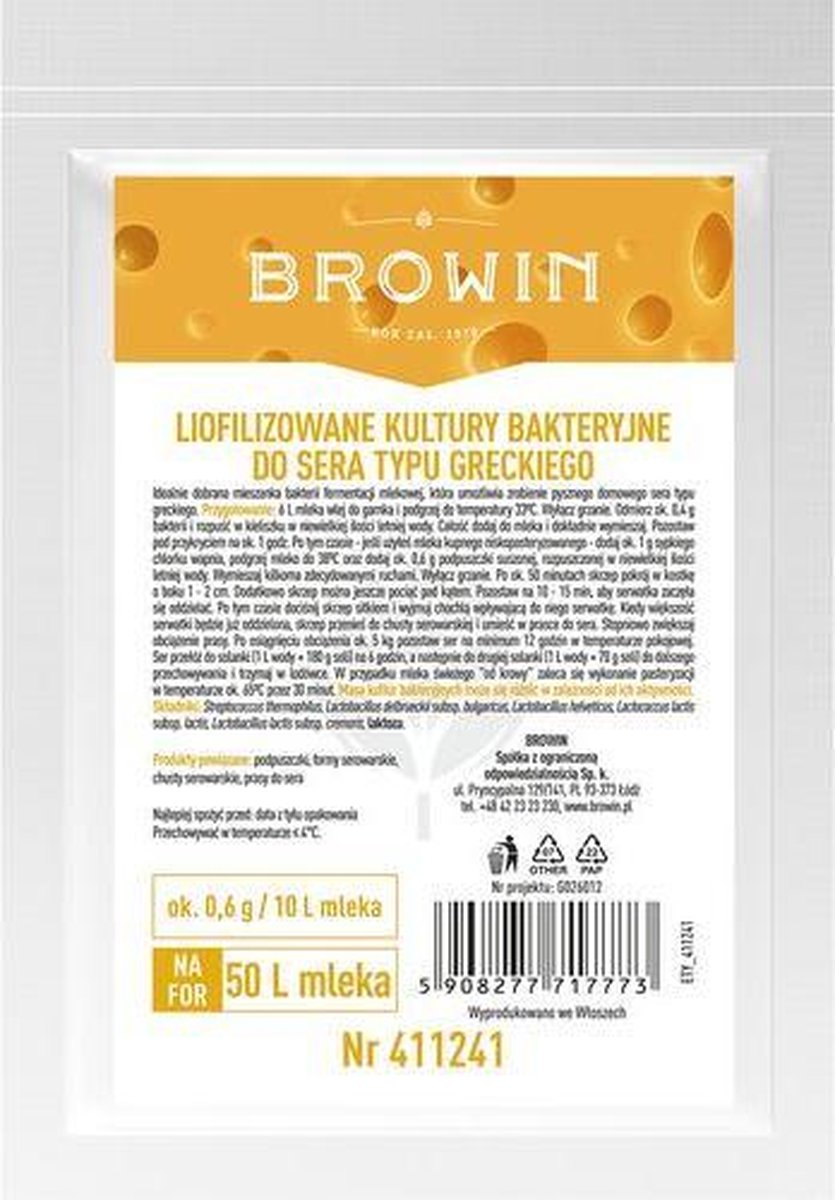
A perfectly selected mix of cultures of milk fermentation bacteria, enabling quick preparation of delicious homemade Greek cheese, constituting an excellent foundation for a healthy diet, also a gluten-free one. Thanks to using freeze drying – a special method of drying that is one of the best food preservation methods – these cultures retain their full potential for a long time.
Significant features:
• For 50 L of milk
• For Greek cheese
How to use:
In case of fresh milk coming “straight from a cow” it is recommended to perform pasteurisation in the temperature of about 65°C for 30 minutes.
Pour 6 L of milk into a pot and heat it up to the temperature of 33°C. Turn off the heat. Measure about 0.4 g of bacteria and dissolve it in a small glass in a small amount of lukewarm water. Add the bacteria dissolved in water and stir everything thoroughly. Leave it under cover for about 1 hour. After that time elapses, add about 1 g of loose calcium chloride if you used low pasteurised milk bought at a store (in case of fresh milk “straight from a cow” the addition of calcium chloride is not necessary), heat the milk up to the temperature of 38°C and add about 0.6 g of dried rennet, dissolved in a small amount of lukewarm water. Stir it with a couple of firm motions. Turn off the heat. After about 50 minutes, cut the curd into 1-2 cm cubes. You can additionally cut the curd at an angle. Leave it for 10-15 minutes so that whey starts to separate. After that time elapses, press the curd with a strainer and take out the whey getting into it with a ladle. Once the majority of whey is separated, move the curd into a cheesecloth and place it inside a cheese press. Increase the pressure gradually. After achieving the pressure of about 5 kg leave the cheese in room temperature for at least 12 hours. Move the cheese into brine (1 L of water + 180 g of salt) for 6 hours, and then to a different brine (1 L of water + 70 g of salt) for further storage. Keep it in a refrigerator.
Ingredients: Streptococcus thermophilus, Lactobacillus delbrueckii subsp. bulgaricus, Lactobacillus helveticus, Lactococcus lactis subsp. lactis, Lactobacillus lactissubsp. cremoris, lactose
Net weight: about 3 g
The weight of bacterial cultures may differ depending on their activity.
Ook bij Amazon
Vergelijk de prijs op Amazon.nl
We mailen je binnen 24 uur een antwoord over de Kaas cultuur voor Griekse kaas / feta. Geen verkooppraat.
A perfectly selected mix of cultures of milk fermentation bacteria, enabling quick preparation of delicious homemade Greek cheese, constituting an excellent foundation for a healthy diet, also a gluten-free one. Thanks to using freeze drying – a special method of drying that is one of the best food preservation methods – these cultures retain their full potential for a long time.
Significant features:
• For 50 L of milk
• For Greek cheese
How to use:
In case of fresh milk coming “straight from a cow” it is recommended to perform pasteurisation in the temperature of about 65°C for 30 minutes.
Pour 6 L of milk into a pot and heat it up to the temperature of 33°C. Turn off the heat. Measure about 0.4 g of bacteria and dissolve it in a small glass in a small amount of lukewarm water. Add the bacteria dissolved in water and stir everything thoroughly. Leave it under cover for about 1 hour. After that time elapses, add about 1 g of loose calcium chloride if you used low pasteurised milk bought at a store (in case of fresh milk “straight from a cow” the addition of calcium chloride is not necessary), heat the milk up to the temperature of 38°C and add about 0.6 g of dried rennet, dissolved in a small amount of lukewarm water. Stir it with a couple of firm motions. Turn off the heat. After about 50 minutes, cut the curd into 1-2 cm cubes. You can additionally cut the curd at an angle. Leave it for 10-15 minutes so that whey starts to separate. After that time elapses, press the curd with a strainer and take out the whey getting into it with a ladle. Once the majority of whey is separated, move the curd into a cheesecloth and place it inside a cheese press. Increase the pressure gradually. After achieving the pressure of about 5 kg leave the cheese in room temperature for at least 12 hours. Move the cheese into brine (1 L of water + 180 g of salt) for 6 hours, and then to a different brine (1 L of water + 70 g of salt) for further storage. Keep it in a refrigerator.
Ingredients: Streptococcus thermophilus, Lactobacillus delbrueckii subsp. bulgaricus, Lactobacillus helveticus, Lactococcus lactis subsp. lactis, Lactobacillus lactissubsp. cremoris, lactose
Net weight: about 3 g
The weight of bacterial cultures may differ depending on their activity.
De Kaas cultuur voor Griekse kaas / feta is een product van Browin. Op deze pagina vind je de volledige productinformatie, actuele prijzen en reviews.
De Kaas cultuur voor Griekse kaas / feta is momenteel verkrijgbaar vanaf € 11,95 bij Bol.com. Prijzen kunnen dagelijks wisselen.
De Kaas cultuur voor Griekse kaas / feta heeft (nog) geen eigen reviewscore. Op Productvraag staat gemiddeld een waardering van 4,85/5 op basis van 1178 reviews van bezoekers.
De Kaas cultuur voor Griekse kaas / feta is verkrijgbaar bij Bol.com. Klik op een aanbieder om direct naar de productpagina te gaan.
De prijzen worden dagelijks automatisch ververst vanuit onze partnerwebshops. De definitieve prijs inclusief eventuele acties zie je op de webshop zelf.
Productvraag verzamelt productinformatie, prijzen en reviews van Nederlandse webshops op één plek. Zo kun je snel zien wat een product kost, wat gebruikers ervan vinden en waar je het kunt kopen.